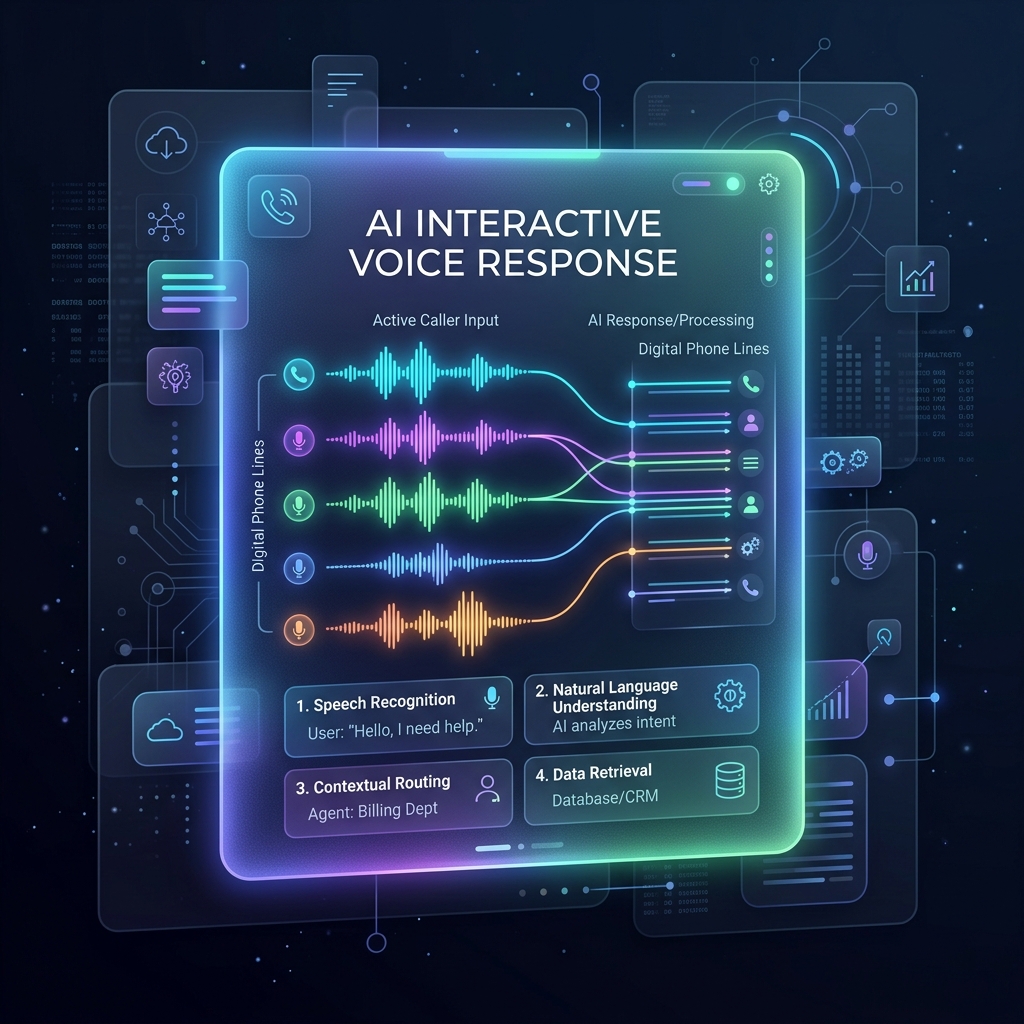
AI IVR and conversational voice assistants are often presented as replacements for the same technology. In practice, they represent different points on a call-automation spectrum.
An AI IVR usually preserves a defined routing structure while adding speech recognition, intent classification, or selected AI steps. A voice assistant may support a more open conversation, use business tools, and complete multi-step tasks.
Neither approach is automatically better. The right choice depends on the workflow, risk, caller behavior, integrations, failure handling, and operating capacity of the team.
A simple definition
AI IVR
An AI IVR combines structured call control with one or more intelligent inputs. It may let a caller press a digit, say a department, describe a reason for calling, or provide a short piece of information.
The system maps that input to a known action such as:
- route to sales;
- route to support;
- look up an order status;
- collect an account number;
- play an announcement;
- transfer to an agent.
The important characteristic is a bounded destination or action model.
Voice assistant
A voice assistant manages a broader conversation. It may ask follow-up questions, maintain context, call approved tools, confirm information, and decide when to transfer.
A complete voice-assistant workflow usually connects:
- telephony;
- speech recognition;
- a model or intent engine;
- text-to-speech;
- prompts and policy;
- business APIs;
- validation;
- fallback and human handoff;
- monitoring and conversation review.
The AI model is only one component.
Key differences
| Decision area | AI IVR | Voice assistant |
|---|---|---|
| Conversation shape | Defined menu, intents, or short input | Multi-turn conversation |
| Caller input | DTMF, speech, or both | Primarily speech |
| Action range | Limited routes and approved actions | Broader tool-assisted workflow |
| Predictability | Usually higher when paths are bounded | Depends more on prompts, model, tools, and context |
| Integration effort | Low to moderate | Moderate to high |
| Testing surface | Menu paths, intents, timeouts, routing | Language variation, context, tools, validation, and routing |
| Fallback | Invalid input, timeout, or transfer | Clarification, retry, safe refusal, or transfer |
| Best starting point | Routing and simple self-service | Defined conversational task with measurable value |
These are tendencies, not guarantees. A poorly designed IVR can be confusing, and a carefully bounded assistant can be predictable.
Choose AI IVR for routing clarity
AI IVR is often a strong starting point when the main goal is to get callers to the correct destination.
Examples:
- “Say sales, support, or billing.”
- “Press 1 for an existing order or 2 for a new purchase.”
- “Tell us briefly why you are calling.”
- “Enter or say your reference number.”
The workflow remains easy to explain and test. Each recognized input maps to a limited destination, and callers can retain a keypad option when speech recognition is unreliable or inappropriate.
Review the NextGenSwitch AI IVR product page and IVR module documentation for configuration context.
Choose a voice assistant for a bounded conversation
A voice assistant may fit when the task requires several dependent steps.
Examples include:
- checking availability and offering appointment times;
- collecting lead details and applying qualification rules;
- retrieving an approved status and explaining the next step;
- creating a support ticket after gathering required information;
- confirming an outbound reminder and recording the response.
The best early use cases are bounded, measurable, and reversible. “Handle any customer request” is not a useful first scope.
The virtual voice assistant integration page explains the surrounding telephony, provider, tool, and handoff layers.
Compare implementation dependencies
Speech recognition
Both approaches may use speech recognition. Test accents, background noise, silence, interruptions, domain vocabulary, numbers, and names.
Provide an alternative input or transfer path when recognition fails repeatedly.
Model or intent provider
An intent classifier that selects among five departments has a different risk profile from a generative model that can call several business tools.
Document:
- the provider and model;
- credentials and quotas;
- latency expectations;
- allowed inputs and outputs;
- data handling;
- timeout and retry behavior;
- fallback when the provider is unavailable.
Text-to-speech and prompts
A conversational assistant normally requires text-to-speech. An IVR may use recorded audio, generated speech, or both.
Keep prompts concise. Confirm important values before committing an action. Avoid reading sensitive information aloud unless identity and privacy requirements are satisfied.
Business tools
Any workflow that reads or changes business data needs controlled API access.
For every tool, define:
- permitted actions;
- authentication and least privilege;
- input validation;
- response validation;
- timeout;
- idempotency where appropriate;
- audit logging;
- user confirmation;
- failure and rollback behavior.
Do not allow a model to invent an order status, appointment, price, payment result, or account change.
Design the human handoff first
Human transfer should be part of the workflow design, not a last-minute escape route.
Define when handoff occurs:
- the caller asks for a person;
- recognition fails repeatedly;
- the request is outside scope;
- identity cannot be confirmed;
- a business tool fails;
- the caller expresses distress or frustration;
- the action is high-impact or prohibited for automation.
Pass useful context to the agent where the integration supports it, but limit the data to what the agent needs and is authorized to access.
Also define what happens when no agent is available: voicemail, callback request, ticket creation, alternative queue, or a concise message.
Use deterministic steps for high-impact actions
AI can help interpret a caller’s request, but important actions should use explicit validation.
For example, an appointment workflow might:
- identify the requested service;
- retrieve approved availability;
- offer a small set of times;
- repeat the selected date and timezone;
- ask for confirmation;
- submit the booking through a controlled tool;
- verify the tool response;
- provide the confirmed result or transfer on failure.
This combines conversational flexibility with deterministic action handling.
Plan consent, privacy, and recording
Before deployment, determine:
- whether calls are recorded;
- which notice or consent is required;
- whether transcripts are stored;
- which providers receive audio or text;
- how long data is retained;
- who can access conversations;
- whether automated outbound calls are permitted;
- how opt-out requests are handled.
Requirements vary by location, industry, call purpose, and provider. Product configuration does not replace legal or regulatory review.
Test more than the happy path
An AI IVR test set should include:
- valid DTMF;
- valid speech;
- ambiguous intent;
- no input;
- invalid input;
- repeated failure;
- unavailable destination;
- after-hours routing.
A voice-assistant test set should additionally include:
- interruptions and corrections;
- conflicting information;
- unexpected questions;
- tool timeout or invalid response;
- model or speech-provider failure;
- attempts to perform prohibited actions;
- sensitive-data requests;
- transfer with and without available agents.
Record expected outcomes. Review real conversations after launch and update prompts, intents, tools, or routing through a controlled change process.
A practical selection framework
Choose AI IVR first when:
- the main goal is routing;
- destinations are known;
- callers benefit from keypad fallback;
- integrations are limited;
- predictable paths matter more than open conversation.
Choose a voice assistant pilot when:
- the task requires multiple conversational steps;
- approved tools can complete or support the task;
- the result can be validated;
- a human fallback exists;
- the team can monitor and improve the workflow.
Use both when a structured front door can route selected intents into a conversational workflow while keeping other calls deterministic.
Start with one measurable call flow
Do not choose the technology from a label alone. Write the caller goal, allowed inputs, business rules, tools, success outcome, prohibited actions, fallback, and measurement plan.
Then compare the implementation surface using the voice API integration guide, AI voice-agent solution, and platform evaluation page.
To test the current interface, open the live demo. For a scoped workflow discussion, contact the NextGenSwitch team.